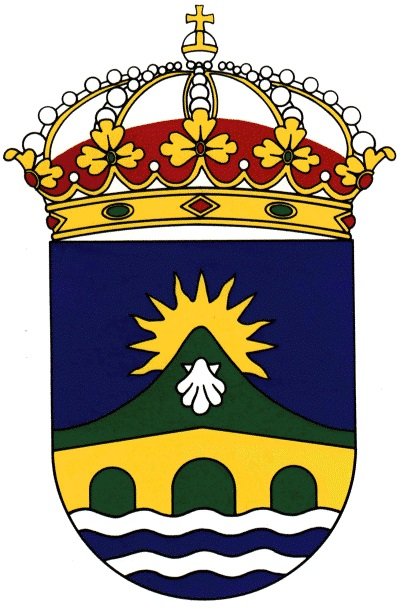

Origins of the municipality
The municipality of Boqueixón was created in the 19th century, during the transition from the Ancien Régime to the liberal state.
The organisation of the Ancien Régime was marked by a confusing proliferation of authorities of all kinds, with functions that were not defined as they are today, acting on vague, overlapping territorial divisions that had little to do with today’s municipalities, since they reflected ties of ownership rather than a genuine administrative division.
Because of its terrain and settlement pattern, Galicia did not have the tradition of municipalities found, for example, in Castile. It had only 57 municipalities, covering a small part of the territory, with large areas of so-called crown land between them. The parish filled this gap, allowing the spontaneous and lively organisation of parish councils, neighbourhood assemblies that dealt with common problems.
The Constitution of Cádiz of 1812 began the attempts to rationalise and simplify this organisation. Galicia was unified as a single province, replacing the seven historical ones. The new single Provincial Council proposed criteria for the new municipal boundaries, but the reaction of the supporters of the Ancien Régime prevented them from being implemented.
The project was resumed at the start of the Liberal Triennium in 1820. In a first proposal, the parishes of today’s Boqueixón were placed in the judicial district of Santa María a Maior e Real de Sar and divided among the new municipalities of Sar, Vilar, Santa Cruz de Rivadulla, Vedra and Touro. The proposal was rejected in 1821 and the district and municipality of Sar were abolished. Sar was replaced by Santa Eulalia de Vigo, which together with Vilar took in most of the parishes of today’s Boqueixón. This new organisation lasted only until 1823, when the Ancien Régime returned.
Today’s territorial organisation dates back to 1833, when the current four provinces, the judicial districts and the municipalities were created. On 25 April 1836 the Official Gazette of the Province of A Coruña, following a royal decree of the regent Maria Christina, published the new territorial division for the whole country, based on mechanical criteria (municipalities were not to exceed four leagues). The civil governor of A Coruña, Pío Pita Pizarro, adapted the decree in 1836 to the particular distribution of the Galician population, giving the parish a central role in the make-up of the municipalities.
That same year, 1836, the Provincial Council of A Coruña drew up its proposed municipal division for the judicial district of Santiago, which already included the municipality of Boqueixón with fifteen parishes (today’s fourteen plus Marrozos, which soon joined the now-defunct municipality of Conxo).
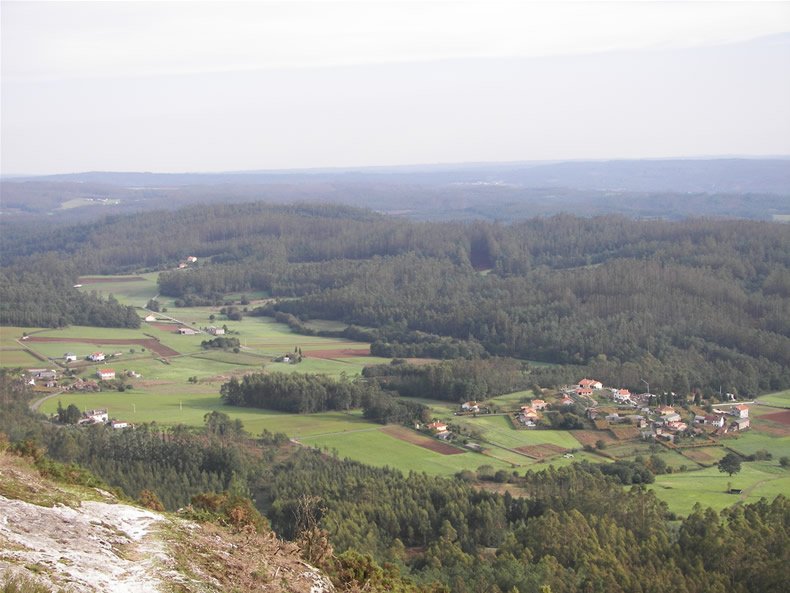
A succession of valleys and hills facing the River Ulla
Institutional history
The municipality of Boqueixón lies in the south of the province of A Coruña, to which it belongs administratively.
Under the Ancien Régime, the parishes that now make up Boqueixón belonged to the jurisdictions of Cira, Granxa, Lestedo and Monte Sacro, Xiro de Rocha, Camanzo and Bendaña, all within the province of Santiago.
In 1820 Galicia was divided into judicial districts and, in a first proposal, the parishes of today’s Boqueixón were placed in the judicial district of Santa María a Maior e Real de Sar and divided among the new municipalities of Sar, Vilar, Santa Cruz de Rivadulla, Vedra and Touro. This proposal was rejected in 1821 and the district and municipality of Sar were abolished. Sar was replaced by Santa Eulalia de Vigo, which together with Vilar took in most of the parishes of today’s Boqueixón. This new organisation lasted only until 1823, when the Ancien Régime returned. In the judicial division of 1834 the district of Sar disappeared and the parishes of Boqueixón were incorporated into the district of Santiago.
It was not until 1836 that the Provincial Council of A Coruña drew up its proposed municipal division for the judicial district of Santiago, which already included the municipality of Boqueixón with fifteen parishes (today’s fourteen plus Marrozos, which soon joined the now-defunct municipality of Conxo).
In 1840 the council was made up of two representatives from each parish, chosen from among the largest taxpayers. In those years there was no town hall: meetings were held in a rented house in the parish of San Vicente de Boqueixón.
In 1868 the mayor, Manuel Couto Maceira, asked the Provincial Council for a grant of 2,000 reales to buy a town hall, but the outbreak of the 1868 revolution brought that council to an end. After the municipality was abolished by the Revolutionary Junta at the end of 1868, the council met in the parish of A Granxa, at the house of Manuel Mareque, the municipal treasurer.
From then until 1950 the town hall had no fixed location and moved between parishes – Lamas, Casanova-Boqueixón, Lestedo, Codeso… – sometimes in rented houses and sometimes in the mayors’ own homes. In 1950, under mayor Antonio Orza Couto, it was decided to establish the municipal seat permanently in O Forte, and the new town hall was opened on 16 November 1953.