Place names
Origins, historical forms and hypotheses about the names of Boqueixón and its parishes.
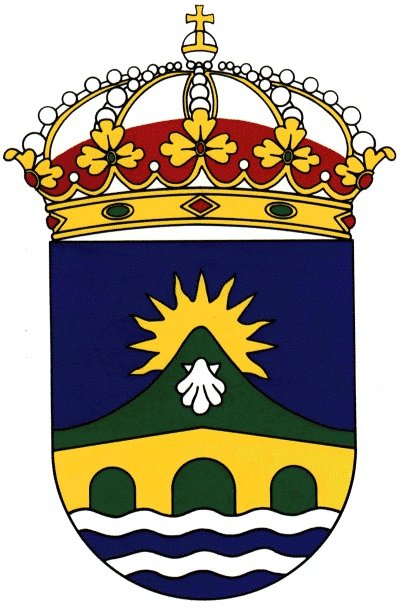
Boqueixón
Cabeza Quiles (2000: 75) links it to Pico Sacro, and more specifically to the existence of a mouth carved into the rock of the mountain. He is referring to the San Xoán da Cova passage, a cleft with a 117 m drop that reaches the river Ulla.
This hypothesis linking boca (mouth) with Boqueixón is probably somewhat bold, but the fact is that place names such as Boqueiro and Boqueira are common in Galicia for openings or holes through which a wall or a rocky mountain is crossed, or where water flows into or out of a pool or channel.
Metaphorical names are not unusual in our toponymy: we often find place names formed with boca (mouth), cabeza (head), costa (back) or lombo (ridge), such as A Boca da Ovella (Mondoñedo, LU); A Boca do Inferno (Lobios, OU) Cabeza de Lobo (Ordes, CO); Lombo da Besta (Muíños, OU), Lombo de Can (Carnota, CO)…
The parishes
Click on the name of each parish to read its explanation.
Codeso
This plant-based place name comes from the plant name codeso, the name of the shrub Adenocarpus complicatus. The plant name comes from Latin cytisus via the Vulgar Latin form *cutisus.
The oldest record of the place name may be the one in a document from 914 (Martínez Lema 2010: 142- 144).
The name was surely given simply because of abundance, that is, a place where this kind of shrub is plentiful.
Donas
The plural form Donas comes from Medieval Latin domna, a reduction of the classical form domina ‘lady’. In the Middle Ages this term was a synonym of nun.
It may refer to the women who founded or owned the estates and settlements that gave rise to the present parish.
Gastrar
The place name may come from the personal name of Germanic origin Wistrarius/Vistrarius, formed from Gothic *wistr– ‘west’ and -arius, from Gothic harjis ‘army’.
In medieval documents the personal name appears as Uistrario, Guistrari or Guistrario. As a place name we find a conf. Petrus Saluatoris de Guistrar (1226) and a Petrus Martini de Guestrar (1322) in the documents of the Tombo de Toxos Outos.
A Granxa
Granxa comes from Vulgar Latin *granica, an adjective from grana ‘grain’, via French grange and the medieval term grangia.
Gonzalo Navaza tells us that in the Middle Ages a granxa or graña (terms very common in place names) was a farm belonging to a monastery, devoted mainly to growing cereals.
Lamas
The place name is clearly the plural of lama, a Latin or pre-Latin word meaning ‘pool, marsh, mire’. In Menéndez Pidal’s opinion it is probably of Ligurian-Illyrian origin.
According to Gonzalo Navaza, lama is a noun of pre-Roman origin that is very common in Galician place names, and in its general sense it means ‘wet ground’.
In some parts of Galicia, lama and its derivative lameiro have come to mean the same as meadow.
Ledesma
- Edelmiro Bascuas considers this a Paleo-European term derived from Bletisăma > *Letisĭma > Ledesma.
- Abelardo Moralejo says that the term goes back to two ancient forms: Led(a)isama, found on Celtiberian coins, and Bletisam(a), in a Latin inscription referring to Ledesma in Salamanca. The author believes that the second form must be pre-Celtic because of its initial consonant, since both would go back to the superlative *pletisama ‘very flat, without slopes’, whose p- had to be dropped in Celtic.
- Juan Moralejo considers Ledesma to be a superlative place name, ‘very wide, very broad land’.
Lestedo
This plant-based place name comes from the grass called lesta (also known as sweet vernal grass – Anthoxanthum odoratum) plus the Latin abundance suffix -edo < -etum .
Lesta itself is of uncertain origin. For Corominas it would be a dissimilation of aresta (from herba aresta > herba lesta).
Other researchers relate lesta to Basque lasto ‘straw’, and therefore consider the term to be of pre-Roman origin, perhaps from a *lista.
Loureda
The name of the parish is a plant-based place name. It comes from classical Latin laurus ‘laurel’ plus the abundance suffix -eta > -eda ‘place where laurels grow in abundance’.
The forms found in CODOLGA record the complete phonetic evolution of the place name: Laureta, Laureda, Loureta and Loureda.
Oural
The first thing to say about the origin of this place name is that it is almost certainly not derived from ouro (gold) or from Latin aura ‘breeze’, as some researchers have suggested.
Edelmiro Bascuas states that Oural derives from a pre-Latin water-related root *aura ‘water’ plus the suffix -al (which indicates a place where something is abundant).
We find it in documents as Aural (914) and Sancta María de Oural (1152).
Pousada
The term comes from Latin pausata ‘pousada’ (past participle of the Latin verb pausare), a place where travellers stop on their way (lodging) and set down (‘pousan’) their loads.
Dictionaries define the noun pousada as ‘a modest inn where people passing through usually stay’, so if there was ever an inn in the parish, this may have been what gave rise to the place name.
In other cases, the fact that the noun is also the surname Pousada may lead us to look for historical records of this surname in the parish and to consider a place name derived from a landowner.
Sergude
Joseph Piel derives the place name from the personal name Sisegutus / Sisegudus / Sesguto. The root Ses- is related to Germanic sisu ‘funeral song’, originally ‘spell, magic’; the change Ses- to Ser- was due to rhotacism. In the scholar’s view, the second element would come from wulthus ‘magnificence’.
In CODOLGA we find the place name in a document from the monastery of San Martiño Pinario, in which other place names of the municipality also appear: de Sancto Felice modium unum; de Lestedo modium unum; de Sergudi modium unum; de Lamas quartarios tres; de Uigo modium unum (ca. 914).
Sucira
Edelmiro Bascuas considers that the origin of the place name lies in the expression *Sub-cira ‘at the foot of (Mount) Cira’ or ‘below Mount Cira’.
According to this author, the term Cira would come from a root *Kei ‘colour’ plus -ria, which would give a supposed *Ciria, from which Cira, a parish in Silleda, would derive.
Vigo
The etymology of the name of the parish is found in the Latin noun vicus ‘rural dwelling, street, village, settlement’.